what gland is located just superior to each kidney?
A deeper dive into the ii functional components of the pancreas: exocrine and endocrine
One Organ, Two Different Functions
The pancreas is really two glands that are mixed together into one organ with ii separate functions.
Digestion (Exocrine)▼
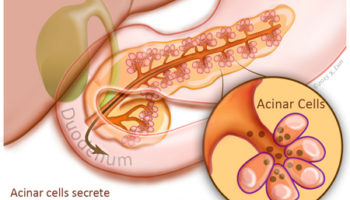
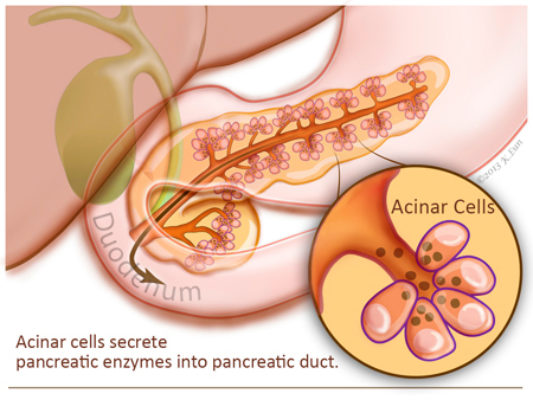
The bulk of the pancreas is composed of "exocrine" (exo=outward) cells that produce enzymes to help with the digestion of food.
These exocrine cells are called "acinar cells" and they produce and ship enzymes that are released into ducts and then passed into the duodenum (the first part of the small bowel), where they assist in the digestion of nutrient.
Claret Sugar (Endocrine)▼
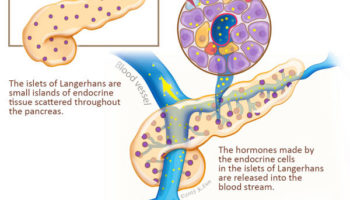
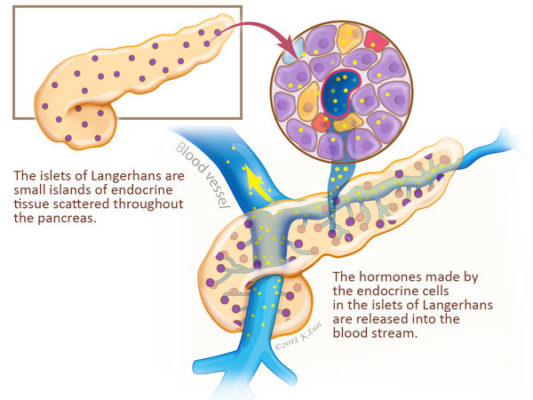
The second functional component of the pancreas is the "endocrine" pancreas. The endocrine pancreas is composed of pocket-size islands of endocrine (endo=inside) cells. The islands are called the islets of Langerhans.
These endocrine cells release hormones such as insulin and glucagon into the blood stream, which maintain the proper level of sugar (glucose) in the blood. Blood sugar is used by the trunk for energy.
Why is this Important?
Agreement the two functions of the pancreas is important because:
Large tumors of the pancreas will interfere with both of these important actual functions.
- Exocrine: when tumors cake the exocrine system, patients can develop pancreatitis and pain from the abnormal release of digestive enzymes into the substance of the pancreas instead of into the bowel, and they can develop digestive problems, such as diarrhea, from the incomplete digestion of food.
- Endocrine: when tumors destroy the endocrine function of the pancreas, patients tin develop saccharide diabetes (abnormally high blood sugar levels).
Tumors can arise in either component, exocrine or endocrine.
- Exocrine: the vast majority of tumors of the pancreas ascend in the exocrine part and these cancers look like pancreatic ducts under the microscope. These tumors are therefore called "ductal adenocarcinomas," or simply "adenocarcinoma," or even more only "pancreatic cancer."
- Endocrine: less commonly, tumors ascend from the endocrine component of the pancreas and these endocrine tumors are called "pancreatic neuroendocrine tumors," or "islet cell tumors" for short.
Third Caste Relatives - Kickoff cousins, great-aunts and uncles
An inherited genetic variation in DNA that yous are born with
Second Degree Relatives - Aunts, uncles, grandparents, nieces and nephews
First Caste relatives - Blood relatives in your immediate family: parents, children, and siblings
This is an experimental type of treatment. It is a medication made of killed or weakened cells, organisms or manufactured materials, which is used to boost the body'due south immune system. Ideally, this will allow the body to fight and kill the cancer cells more finer. Vaccines include whole killed cancer cells or specific proteins from the cancer.
Likewise known as a pancreatoduodenectomy, the Whipple procedure is the surgery typically performed to remove cancers of the head of the pancreas (the part of the pancreas on the right side of your trunk). Information technology typically involves the surgical removal of the caput of the pancreas, a portion of the duodenum and a portion of the bile ducts.
The office of the pancreas that bends backwards, hooking around two very important blood vessels, the superior mesenteric artery and vein. The word "uncinate" comes from the word uncus which means "hook."
Unable to be surgically removed. This usually ways that the cancer has spread beyond the areas that can exist removed surgically.
This term just refers to a "mass" or tumour. For instance, a collection of pus is a tumor. This is a full general term that tin refer to either benign or malignant growths.
A painless procedure in which loftier frequency sound waves are used to generate pictures of the inside of the torso. An ultrasound devise can exist placed at the finish of a scope, and the scope inserted into the duodenum, providing very detailed pictures of the pancreas. This is chosen "endoscopic ultrasound."
A jell within the blood vessels. It may occlude (block) the vessel or may be fastened to the wall of the vessel without blocking the claret menses.
An inflammation of the veins accompanied by thrombus formation. It is sometimes referred to every bit Trousseau's sign.
Excessive amounts of fat in the stool. Sometimes this tin can announced equally an oil slick on top of the toilet water after the patient has had a bowel movement. It can be a sign that the pancreas isn't functioning well.
A slender hollow tube inserted into the body to relieve a blockage. For example, pancreas cancers often grow into the bile duct as the bile duct passes through the pancreas. This can block the flow of bile and cause the patient to become jaundiced. In these cases the period of bile can be reestablished by placing a stent into the bile duct, through the expanse of blockage.
The long sparse part of gland in the left role of abdomen, near the spleen.
A maroon colored, rounded organ in the upper left office of the abdomen, near the tail of the pancreas. This organ is function of your immune system and filters the lymph and blood in your body. It is often removed during the distal pancreatectomy surgical procedure.
A apartment, scale-like cell. Although most pancreatic cancers await similar ducts under the microscope, a minor fraction await like squamous cells.
A classification arrangement that is used to describe the extent of disease. Clinicians use it to predict the probable survival of a patient.
An infection of the claret. This can be life-threatening and is oftentimes treated with antibiotics.
A long (20 foot) tube that stretches from the tummy to the large intestine. It helps blot nutrients from food as the food is transported to the large intestine. At that place are three sections: the duodenum, the jejunum and the ileum. Due to its proximity to the pancreas, the duodenum is the section of the minor intestine nigh frequently afflicted past pancreatic cancer.
The use of high-energy waves similar to x-rays to care for a cancer. Radiation therapy is usually used to treat a local area of disease and frequently is given in combination with chemotherapy.
Able to be removed surgically. Usually this means that the cancer is confined to areas typically removed surgically.
A malignant tumor that looks like connective tissues (bone, cartilage, muscle)under the microscope. Sarcomas are extremely rare in the pancreas.
A cancer in the organ where it started in. A primary cancer of the pancreas is one that started in the pancreas as opposed to a cancer that started somewhere else and only later spread to the pancreas.
A forecast for the probable outcome of a disease based on the experience of large numbers of other patients with similar stage illness. Importantly, making a prognosis is not an exact science. Some patients with poor prognosis beat the odds and alive longer than anyone would take predicted. Steve Dunn'southward Cancer Guide has an excellent article on statistics and prognoses and stories of other cancer patients.
A thick ring of muscle (a sphincter) between the stomach and duodenum. This sphincter helps control the release of the stomach contents into the small intestine.
A medical doctor specially trained to written report illness processes. Pathologists make the microscopic diagnosis that is used to constitute the diagnosis of cancer.
Around the ampulla of Vater in the duodenum. The peri-ampullary region is comprised of 4 structures; the ampulla, the duodenum, the bile duct and the head of the pancreas. It is sometimes difficult to tell which construction a tumor originated in. In such cases the diagnosis will be a peri-ampullary tumor.
The biochemical study of plants; concerned with the identification, biosynthesis, metabolism of chemical constituents of plants; especially in regards to natural products.
An ellipsoidal organ located between the stomach and the spine. The pancreas secretes enzymes needed for the digestion of nutrient and information technology produces hormones such as insulin and glucagon which assist control blood carbohydrate.
Whatever treatment that reduces the severity of a disease or its symptoms. Palliative care is oft a office of the treatment program for patients with advanced pancreatic cancer.
A term used to describe certain tumors which grow in finger-like projections. Pathologists utilise this term to describe some precancerous lesions in the pancreas (intraductal papillary mucinous neoplasm).
An aberrant new growth of tissue that grows more than rapidly than normal cells and will continue to abound if not treated. These growths will compete with normal cells for nutrients. This is a full general term that can refer to benign or malignant growths. It is a synonym for the discussion tumor.
A medical doctor who specializes in the treatment of tumors. Oncologists often treat patients with pancreatic cancer with chemotherapy.
A surgically created opening in an organ that tin also be referred to as an anastamosis. Sometimes when surgeons remove a segment of bowel they create an ostomy to permit for the bowel contents to exit the body.
A cancer that has spread from one organ to another. Pancreas cancer most often metastasizes to the liver. In general, cancers that have metastasized are more often than not not treated surgically, but instead are treated with chemotherapy and/or radiation therapy.
An alteration in the Deoxyribonucleic acid of a jail cell. Remember of it equally a typographically error in the DNA code.
The thin section of the pancreas between the head and the body of the gland.
Chemotherapy and radiation therapy that is given to patients before surgery. Some centers experience that the employ of neoadjuvant therapy improves local and regional control of disease and that information technology may brand more patients surgical candidates.
A cancer that has the potential of invading nearby tissues, spreading to other organs (metastasizing) and possibly leading to the patient's death.
Normal, circular, raisin to grape-sized collections of lymphocytes (white blood cells) found throughout the torso. Lymph nodes are connected to each other past lymphatic vessels. They normally assist fight infection, but also are i of the outset sites to which cancers spread. In general, the spread of cancer to lymph nodes portends a worse prognosis for the patient. In that location are exceptions to this.
A painless method for visualizing internal organs. A tube-like machine with a powerful magnet generates images of the inside of the trunk. It does not involve the use of Xrays.
The largest organ in the body, located in the right upper part of the abdomen. Information technology performs many life-maintaining functions including the production of bile. The liver detoxifies the blood of drugs, alcohol and other harmful chemicals. It processes nutrients absorbed by the intestine and stores essential nutrients, vitamins and minerals. Bilirubin is a chemic produced when old or damaged claret cells breakup. The liver chemically procedure the bilirubin so that it can dissolve in water and be excreted through the urine. When this process is disrupted, jaundice can develop.
A main pancreatic cancer that has spread to regional lymph nodes and/or resectable (removable) tissues. Removable tissues include some lymph nodes and parts of the duodenum and stomach that are routinely removed in some surgical treatments for pancreatic cancer.
Yellowing of the pare or yellowing of the whites of the optics caused by the aggregating of bile pigments (usually due to an obstruction of the bile ducts).
A technique that surgeons tin can utilize to visualize and even biopsy (take tissue samples of) organs within of the abdomen without making large incisions. Very modest incisions are made in the belly and small tubes (called trocars) are then inserted. Gas is pumped in through ane of the tubes to create enough space to work in. The surgeon inserts a modest camera through one of the tubes and examines the lining and contents of the abdominal cavity by looking at the projected image on the television screen. With particularly designed laparascopic instruments, biopsies and fluid samples can be taken for examination. Some surgeons feel that this technique can help "stage" a patient less invasively than with open surgery.
A term used to indicate that cancerous cells are present in the duct but accept not yet invaded deeper tissues.
A hormone produced by the endocrine cells of the islets of Langerhans cells of the pancreas. Insulin acts to lower blood sugar levels.
The widest part of the pancreas. It is found in the right office of belly, nestled in the curve of the duodenum, which forms an impression in the side of the pancreas.
A hormone produced past the endocrine (islets of Langerhans) cells of the pancreas. When blood sugar levels are low, glucagon acts to heighten blood sugar levels.
A chemotherapeutic drug usually used to care for pancreatic cancer.
A green pear-shaped organ located on the right side of the abdomen just under the liver. The gallbladder is essentially a reservoir for holding bile.
Gemzar is the trade proper noun for the chemotherapy drug gemcitabine. Information technology is frequently used to treat pancreatic cancer. Information technology has been shown, in controlled clinical trials, to ameliorate quality of life.
The exocrine cells (acinar cells) of the pancreas produce and transport chemicals that will exit the body through the digestive system.
The chemicals that the exocrine cells produce are called enzymes. They are secreted in the duodenum where they aid in the digestion of food.
A chemical that causes a reaction in other substances, in this case as a office of the digestive procedure.
A test used to visualize and examine the pancreas and bile ducts. A tube is inserted through a patient's nose (or throat), downwardly through the esophagus and stomach then into the modest intestine (duodenum). There, a small-scale probe is inserted into the ampulla of Vater. A dye is injected through the probe and into the pancreatic and bile ducts. X-rays are then taken to visualize the pancreatic and bile ducts. these ducts can exist seen as white structures (this is because the injected dye is opaque). Because pancreas cancers often block the pancreatic and/or bile ducts, this technique can be useful in establishing a diagnosis of pancreas cancer.
Surgical removal of a structure or part of a structure. For example, pancreatectomy is the surgical removal of the pancreas (or a portion of it).
These are specialized cells that produce hormones released into the bloodstream. For example, the islets of Langerhans are endocrine cells in the pancreas that produce the hormone insulin. This hormone helps control claret saccharide(glucose) levels.
Some rare tumors of the pancreas, the endocrine (Islet Cell) tumors, tin can produce these aforementioned hormones. It is very important that these rare tumors exist properly diagnosed because information technology will determine the treatment and prognosis.
A medical doctor who specializes in the treatment of hormonal abnormalities.
The start portion of the small intestine. It is about one pes long. It is the part of the intestinal rail that comes after the tum.
A dome shaped musculus that separates the lungs and heart from the abdomen. This muscle assists in breathing.
The chemical in every jail cell that carries genetic information.
A small anatomic construction. This is essentially a tube that carries diverse bodily fluids. The pancreatic duct runs the full length of the pancreas and drains into the duodenum.
The disease in which the torso is unable to appropriately control blood sugar (glucose) levels. This may be acquired past failure of the pancreas to produce acceptable amounts of insulin.
A dye, taken past mouth or injected, that is sometimes used during ten-ray examinations to highlight areas that otherwise might not be seen.
A fluid filled sac. Some tumors of the pancreas, including the serous cystadenomas and intraductal papillary mucinous neoplasms, form cysts. Cysts take a distinct appearance in CT scans. They are of import to recognize because the handling of cystic tumors can differ from that for solid tumors.
A small, flexible tube inserted into the torso to inject or suck out fluids.
The handling of a cancer by chemicals. For pancreatic cancer these include: Gemzar (Gemcitabine), 5-flurouracil, leukovorin, taxol, and others.
A way to epitome internal organs. A series of ten-ray pictures taken by a auto that encircles the body like a behemothic tube. Computers are and so used to generate cross-exclusive images of the inside of the body.
A cancer-causing chemical. Cigarette smoke contains a number of carcinogens.
A blood mark for pancreas cancer. It is non a proficient screening test for diagnosing possible pancreas cancers in individuals without symptoms. Instead, it can be useful in following the progress of patients known to have a cancer past measuring how their cancer is responding to treatment.
A dramatic weight loss and general wasting that occurs during chronic disease.
A malignant tumor. Information technology has the potential of invading into the adjacent tissues, spreading to other organs and may eventually lead to the patient's death.
The middle part of the pancreas betwixt the neck and the tail. The superior mesenteric blood vessels run behind this part of the gland.
A green fluid produced by the liver that helps digest fats. Information technology is transported from the liver to the duodenum by the bile duct. When the flow of bile is blocked, patients may become jaundiced (yellow skinned).
A duct that carries bile from the liver to the intestine. This term may refer to the hepatic, cystic or mutual bile duct.
The removal and microscopic examination of a small-scale tissue sample.
Tumors which are non-malignant. These by and large grow slowly and practice non invade adjacent organs or spread (metastasize) beyond the pancreas.
A radiographic technique used to visualize blood vessels. A contrast medium (a dye) is usually injected into the vessels to make them appear white on the x-rays.
The large artery that carries oxygen-rich claret from the heart. From the heart it arches backwards and descends into the abdomen where information technology gives off many branches to supply the organs. The superior mesenteric artery is a major branch of the aorta that can be involved by pancreatic cancer.
The drove of excess amounts of fluid in the intestinal crenel (belly). It oftentimes is a sign that the cancer has spread to either the liver or to the portal vein that goes to the liver, or that the cancer involves the internal lining of the belly. If normal liver function is affected, a complex ready of biochemical checks and balances is disrupted and abnormal amounts of fluid are retained.
A surgical joining of two hollow structures. It is like to attaching ii ends of a garden hose. For example, a gastrojejunostomy is a surgical procedure that connects the stomach and the jejunum (small intestine.)
A status characterized by a deficiency in red claret cells. This tin lead to fatigue among other symptoms.
A condition marked by a diminished apetite and aversion to food. Often results in physical signs of wasting.
Chemotherapy given to patients later their cancers have been surgically removed. Information technology is a secondary treatment given to supplement surgical treatment. (encounter Neoadjuvant chemotherapy which is chemotherapy given before surgery)
This widening of the pancreatic duct as it reaches the duodenum is an landmark for physicians. Information technology is where the bile duct and pancreatic duct join before draining into the duodenum (small-scale intestine). Tumors in the head of the pancreas may squeeze this duct partially or completely airtight. This can lead to problems with digestion and jaundice.
A benign (non-cancerous) tumor made up of cells that form glands (collections of cells surrounding an empty space).
The class of cancer that well-nigh people are talking near when they refer to "cancer of the pancreas." These tumors account for 75% of all pancreas cancers.
Microscopically, adenocarcinomas class glands. These tumors can grow large enough to invade nerves which can crusade back pain. They too ofttimes spread (metastasize) to the liver or lymph nodes. If this happens the tumor may exist considered unresectable.
The portion of the trunk between the diaphragm and the pelvis.
A pus-filled crenel. Usually acquired by an infection.
hoskinaluslaccoich.blogspot.com
Source: https://pathology.jhu.edu/pancreas/basics/function
0 Response to "what gland is located just superior to each kidney?"
Post a Comment